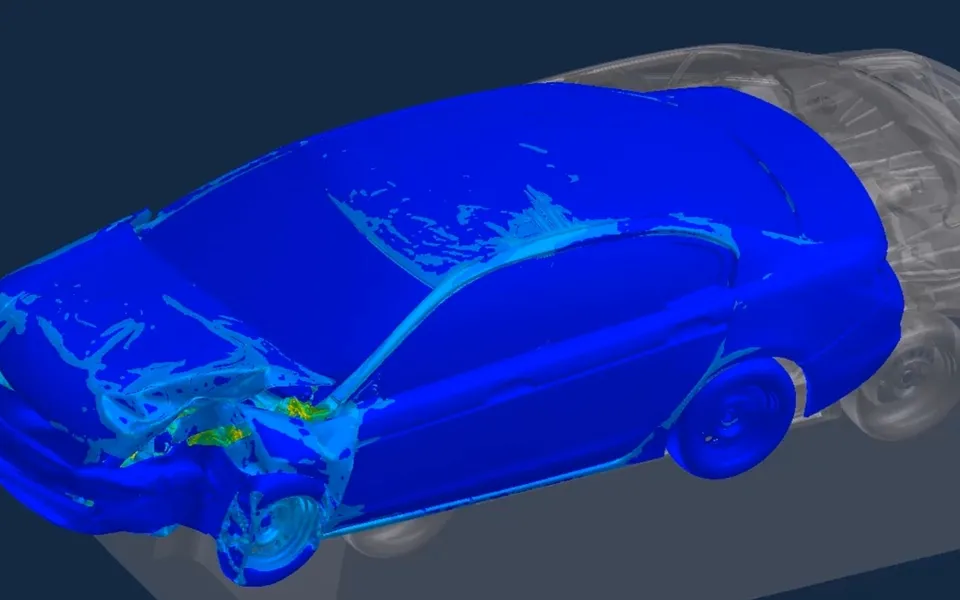
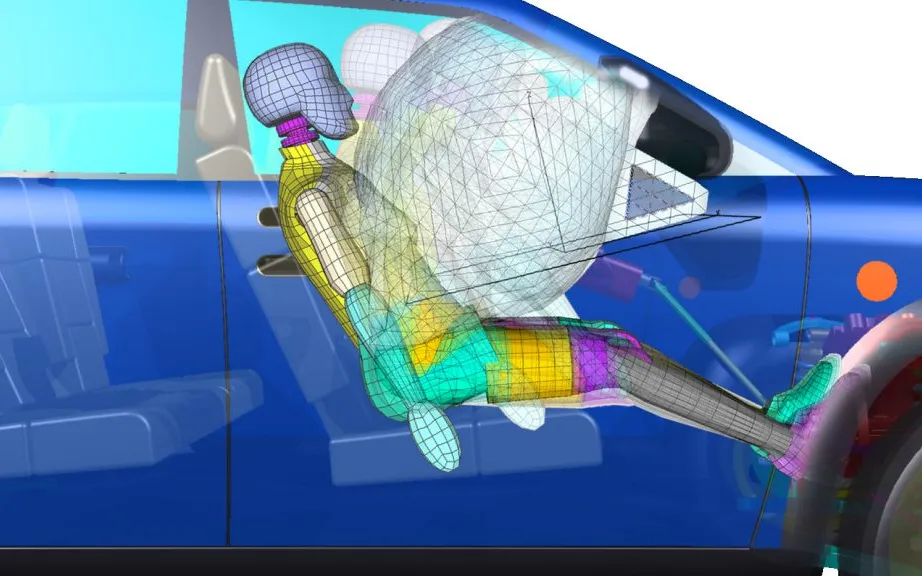
Crash test dummy simulation with Hybrid III, THOR and WorldSID models you can defend
A dummy model is a measuring instrument. Which build it represents, how it was checked against certification corridors and how its channels are processed decide whether a restraint or side-impact result is a finding or a guess.
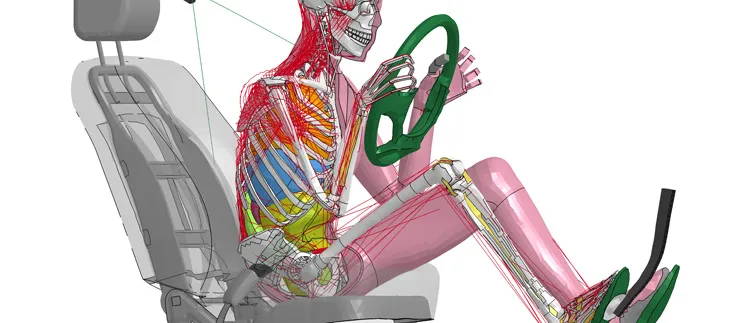
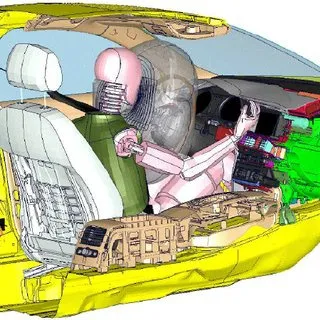
Crash test dummy simulation puts a finite element model of a Hybrid III, THOR or WorldSID dummy into your restraint, sled or vehicle model, so head, neck, chest and pelvis loads can be read before the hardware test is built. It is only as good as the model's validation record, so we set up the certification checks, the hardware-build record and the automated runs as a workflow your team keeps, around your existing crash solver.
The review starts with a chest-deflection curve that does not match the sled. For an hour the belt and the airbag model take the blame. Then someone asks which version of the dummy model was in the run, with which spine, on which solver release, and nobody can say. The restraint release waits on that answer. A dummy model is a measuring instrument, and without its calibration on file no discrepancy can be assigned to the restraint, the dummy or the pulse.
What does a crash test dummy simulation actually predict?
A dummy model reproduces the mass, geometry, joints and deformable parts of an anthropomorphic test device and reports the channels the hardware records: accelerations, forces, moments and deflections. Injury criteria are computed from those channels, not from anatomy. For the head, HIC = max (t2 − t1) [ 1/(t2 − t1) ∫ a dt ]2.5, with a the resultant head acceleration in g and, for HIC15, a window of at most 15 ms. For the Hybrid III of 49 CFR Part 572 Subpart E, 49 CFR 571.208 (FMVSS No. 208) requires HIC15 not above 700 and Nij = Fz/Fzc + Mocy/Myc not above 1.0, with neck forces filtered at channel frequency class 600.
Two consequences follow. A criterion and its limit are defined on one dummy's channels, so they do not transfer to another dummy. And filter, sampling and window are part of the criterion, so test and simulation channels need identical processing. The Euro NCAP side impact protocol (version 1.1, October 2025) asks for sled and virtual test data at 10 kHz sampling.
Which dummy model do you need: Hybrid III, THOR or WorldSID?
The programme decides. In its MPDB frontal impact testing protocol (version 1.1.1, October 2019), Euro NCAP puts a THOR 50th percentile male on the driver seat and a Hybrid III 50th percentile male, to Part 572 Subpart E, on the front passenger seat. Its side impact protocol (version 1.1, October 2025) specifies the WorldSID 50th percentile male for the driver in the AE-MDB, pole and far side sled tests. In the United States NHTSA proposed adding the THOR-50M, designed for frontal crash tests, to Part 572 in September 2023, and its supplemental notice of 22 September 2026 asks for comment on an additional spine configuration and an alternative face foam.
“THOR” is not one configuration. Technical Bulletin TB 026 (version 1.3, February 2023) builds on the THOR-50M drawing package at standard build level B, then changes it: an on-board data acquisition system, a four-position spine box set to the +9 degree “slouched” posture, and Hybrid III lower legs. Your model has to state which build it represents, because a model of the wrong build is a valid model of the wrong dummy.
How is a dummy model validated, and what does a passed certification prove?
Hardware dummies are certified in component tests with published corridors, and a dummy model starts with the same tests. For the Hybrid III, 49 CFR Part 572 Subpart E specifies a head drop from 14.8 inches with a peak resultant acceleration between 225 g and 275 g, and a neck pendulum flexion test in which the head plane rotates between 64 and 78 degrees, between 57 and 64 ms. A thorax probe impact at 22 fps meets a force of 1242.5 ± 82.5 pounds, a sternum displacement of 2.68 ± 0.18 inches and a hysteresis between 69% and 85%. THOR certification in TB 026 covers the head, six neck conditions, thorax, abdomen and upper legs, each parameter with a lower and an upper limit.
Passing these is necessary and not sufficient. A certification test loads one segment, in one direction, at one rate, while a belt and an airbag load chest, neck and pelvis together. Validation is therefore a ladder: component corridors, then the assembled dummy on a sled with the real restraint and a recorded pulse, then the vehicle test. Parameters are identified at the lowest level that can see them and frozen before the next.
- Component certification. The dummy model repeats the hardware certification tests: for the Hybrid III a head drop, a neck pendulum and thorax and knee impacts; for the THOR the head, six neck conditions, thorax, abdomen and upper leg. Uncertain parameters such as foam, rib damping and joint friction are identified here, where one segment is loaded at a time.
- Corridors. Each certification parameter has a lower and an upper limit. The model response must sit inside the band in peak, timing and shape. Passing every corridor is necessary and not sufficient: each test loads one segment, in one direction, at one rate.
- Sled with the real restraint. The assembled dummy model sits in the seat with the belt and airbag under a recorded crash pulse. Chest, neck and pelvis now load together, and positioning and belt routing enter the comparison. Test and model channels are filtered and processed identically before they are compared.
- Vehicle test. The full vehicle pulse and the interior contact. It is used to check the model, not to tune it: a mismatch sends you down the ladder to find the level where the error enters, instead of adjusting dummy parameters until the curves agree.
- Identify low, freeze, move up. Each parameter is identified at the lowest level that can see it and frozen before the next level. Any later change is a new model version, with its own record.
- Model record. Stored with the model: the hardware build it represents, the solver release, the corridor overlays, the channel ratings against tests and the range of conditions it covers. It is what lets a reviewer or a test lab see what the model was checked against.
What do rating programmes accept from a virtual dummy?
Less than many teams expect. The Euro NCAP side impact protocol (version 1.1, October 2025) lets a manufacturer submit CAE predictions of the protection level, and uses them only when they cover all full-scale tests and dummies and the official test agrees within 25% of the colour band width for each criterion. Otherwise the measured results decide. Far side protection is assessed from virtual data supplied by the manufacturer, and Euro NCAP picks one AE-MDB and one pole case for physical sled validation of the virtual setup. The physical test stays, and the model has to be right where it is checked. Acceptance of any virtual evidence is agreed with the authority or the programme, and OLTRION does not certify, rate or approve anything.
Where do human body models fit beside dummies?
A dummy is an instrumented, passive mechanical device built for robustness and repeatability. A human body model (HBM) is a finite element representation of anatomy that reports strain and stress in tissue. Fahse and co-authors, in a 2023 review of dynamic human body models in vehicle safety, describe ATDs as devices that remain part of vehicle certification, and HBMs as models that run without a prototype and carry enough anatomical detail for tissue-level injury predictions.
They answer different questions. The dummy answers “what does the programme's criterion read?”, because in every text cited here criteria and limits sit on dummy channels. The HBM answers “how does the load travel through ribs, neck or pelvis, and does it change with body size or posture?”. Strain in a rib has no programme limit by itself: it needs a risk function written for that model version and that tissue, quoted with its source. Neither replaces the other in a rating or a regulation.
- Dummy model and its inputs. A crash pulse enters through the seat, and the belt loads the torso. The dummy model carries the mass, geometry, joints and deformable parts of the hardware and answers with the same kind of signals the physical dummy records.
- Channels. Accelerations, forces, moments and deflections at the sensor locations: head centre of gravity, upper neck, sternum relative to the spine, femur. Filter class, sampling and window are part of each criterion, so test and model channels go through the same processing.
- Criteria. Each criterion is computed from channels. HIC15 comes from the resultant head acceleration over a window of at most 15 ms; Nij combines neck axial force and occipital condyle moment, each over its critical value. They are defined on the channels of one dummy.
- Risk function. A curve from a criterion value to a probability of an injury level, for one dummy, one body region and one injury definition. It comes from published biomechanical data and is quoted with its source.
- Programme limits. The regulation or rating programme sets the limits on dummy channels, such as HIC15 not above 700 for the Hybrid III in FMVSS 208, or the higher and lower performance limits per criterion in the Euro NCAP side impact protocol. The limit belongs to the programme, not to the model.
- Human body model. A finite element model of anatomy that reports strain and stress in ribs, neck or pelvis, and can be varied in size and posture. The dummy criteria above do not apply to it: its tissue output needs a risk function written for that model version and that tissue.
| Your question | Model | What the texts define | State in the record |
|---|---|---|---|
| Frontal restraint design on a Hybrid III basis | Hybrid III 50th male | Part 572 Subpart E tests; FMVSS 208 criteria | Model and solver version, filtering |
| Frontal programme work with THOR on the driver seat | THOR-50M | TB 026 build level and corridors | Spine box, data acquisition, legs |
| Side impact, pole and far side | WorldSID 50th male | Euro NCAP specification, positioning, criteria | Positioning deviations |
| Another body size or posture, or the load path through tissue | Human body model | No dummy corridor; validation is per model version | Model version, risk function and source |
| Many restraint variants before hardware exists | Surrogate over a validated dummy model | Runs from the validated model | Stated range and a gate to the full model |
Freeze the dummy model before you correlate
Where does AI help dummy simulation, and where does it not?
- Calibration. Foam, rib damping, joint friction and skin stiffness are uncertain. A planned set of component runs and a Bayesian calibration against the corridors return parameter ranges with their uncertainty, not one tuned value.
- Automated rating. Scripts overlay every certification and sled channel on its corridor, rate phase, magnitude and shape, and flag drift when a version changes.
- Surrogates. A surrogate of HIC15, Nij and chest deflection over seating position, belt anchorage and crash pulse, trained on designed runs with the dummy model in the loop, covers more variants than the run budget would, most of all with an HBM. See surrogate models for CFD and FEA.
- Anomaly gates. Energy balance, hourglass energy and contact penetration are checked before a run's channels enter a comparison.
AI does not stand in for the dummy. A network trained on a handful of sled tests learns that sample's pulse and belt, and extrapolates without warning. Injury values come from the validated model and the programme's criterion; a surrogate only decides where to run them, within a stated range, and outside it the request goes to the full model. See AI surrogate models you can sign off, and for the whole crash model, a crash simulation model you can trust.
From one validated dummy model to a capability you keep
The return comes when your team can add the next dummy build or solver release and see within a run whether the record still holds.
- Physics model. CFD and FEA set up once, as templates: geometry clean-up, mesh, solver settings and post-processing that every later run reuses.
- Validation. Mesh and time-step studies, and comparison with tests or full-scale data, so the model's uncertainty is known before it is trusted.
- Automated runs. Scripted runs over the parameters and operating conditions that matter, on your hardware or in the cloud.
- AI surrogate. A machine-learning model trained on those runs answers in seconds and says how sure it is; low-confidence questions go back to the solver.
- Decision tool. Optimisation, trade-off charts or operating guidance, in a form your engineers and operators use every day.
- Field data. Test, trial and monitoring data flow back to recalibrate the model, so it improves with every project instead of being rebuilt.
- A dummy model register: model and version, hardware build (spine, instrumentation, legs), solver release and filtering, stored with every run.
- The certification suite as an automated check, run on every new model version, solver release or mesh change, with the corridor overlays kept.
- A positioning template that reproduces the protocol. Euro NCAP's side impact protocol places the WorldSID H-point within a ±10 mm square in X and Z of a defined point. The model carries the same tolerance and records deviations.
- One post-processing library for HIC15, Nij, chest deflection and your programme's other criteria, applied unchanged to test and model channels.
- A correlation record against your sled and vehicle tests, with the pulses, restraints and occupant sizes it covers.
- A surrogate with a stated range over the variables your restraint team changes, and a gate that returns out-of-range requests to the full model.
- Handover and training, so your engineers extend it themselves. See our training and software development services.
Questions engineers ask about crash test dummy simulation
What is a crash test dummy model?
Which dummies does Euro NCAP use?
How do you validate a dummy FE model?
Can a human body model replace a dummy?
What do you need from us to start?
If a dummy channel does not match the test, or a dummy model has no record you can show, send us the dummy model and its version, the solver release, one restraint or sled model and the test channels with their filtering. We will reply with the certification checks we would run first, where the model is most likely to disagree with the hardware, and what the first model record would let your team decide. Start with a conversation, or read about our dummy simulation work and the crash test simulation section.