Seakeeping and manoeuvring simulation: designing ships for the sea they will actually meet
Calm-water performance sells a design; behaviour in waves decides whether it works. How spectral methods, potential flow and CFD predict motions, slamming, added resistance and manoeuvrability, and how to keep those answers in use.
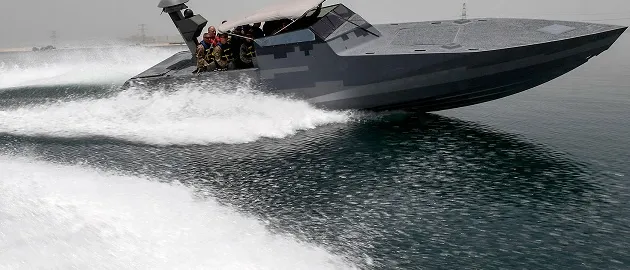
Seakeeping simulation predicts how a ship will move, slam and lose speed in waves, long before it leaves the yard. A hull optimised only for calm water can pitch hard, ship green water over the bow or need far more power than planned once the sea gets up. Manoeuvring simulation then asks whether it can still turn, stop and hold a course.
These questions decide crew comfort and safety, cargo and equipment loads, operability windows for offshore and naval missions, and the fuel burnt at sea rather than on trial. They also sit inside rules. The IMO's guidelines on minimum propulsion power (MEPC.1/Circ.850/Rev.3) ask whether a ship keeps enough power to manoeuvre in adverse conditions. The IMO Standards for Ship Manoeuvrability set limits on turning, course-keeping and stopping.
Six motions, two disciplines
A ship in waves moves in six degrees of freedom: surge, sway and heave along its axes, and roll, pitch and yaw about them. Seakeeping is mostly concerned with the vertical motions (heave, pitch and roll) and with the accelerations, relative motions and loads they cause. Manoeuvring is concerned with the horizontal ones (surge, sway and yaw) and with the forces from hull, rudder and propeller.
In real seas the two couple. A ship turning in waves also rolls, and a ship running in steep following seas can lose directional control altogether. Good simulation treats them as one problem when the question demands it, and separately when it does not.
Seakeeping simulation with the spectral method
Most seakeeping work starts in the frequency domain. An irregular sea is described by a wave spectrum Sζ(ω), such as JONSWAP or Pierson–Moskowitz, for a given significant wave height and peak period. The ship is described by its transfer functions, or response amplitude operators (RAOs): the response per unit wave amplitude at each frequency and heading.
- Sea state. A wave spectrum, for example JONSWAP, spreads wave energy over frequency for a given significant height and peak period.
- Transfer function (RAO). Response per unit wave amplitude at each frequency and heading: from potential flow, or from CFD where motions are large and nonlinear.
- Response spectrum. The wave spectrum times the RAO squared. Its area gives significant motion amplitudes; its tails give the odds of slamming and deck wetness.
- Six degrees of freedom. Surge, sway, heave, roll, pitch and yaw. Seakeeping is mostly about the vertical motions, manoeuvring about the horizontal ones; in waves they couple.
- Added resistance in waves. The extra thrust needed to hold speed in a seaway: a real share of fuel use at sea, and part of the minimum-power question.
Multiplying the two gives the response spectrum, SR(ω) = |H(ω)|2 Sζ(ω). Its zeroth moment m0 sets the significant amplitude, about 2√m0, and its shape gives the probability of events such as slamming, propeller emergence or deck wetness. Because a moving ship meets waves at the encounter frequency ωe = ω − ω2V cos μ / g, speed and heading change the answer as much as the sea itself.
Repeat this over the sea states of a route or operating area, and weight each by how often it occurs. The result is operability: the share of time the ship can do its job within limits on motion, acceleration and slamming. It is one of the most useful numbers a design team can have, and one of the least often computed.
Which method for which question
| Method | Strengths | Limits | Typical use |
|---|---|---|---|
| Strip theory | Very fast; robust for slender hulls at moderate speed | Weak for full forms, high speed and large motions | Early design, operability screening |
| 3D panel method (potential flow) | Full 3D hull, diffraction and radiation, several bodies | Linear; viscous roll damping must be added | RAOs, wave loads, multi-body and offshore work |
| Nonlinear time-domain potential flow | Large motions and nonlinear restoring | Viscous effects still modelled empirically | Extreme responses, parametric roll |
| CFD (RANS with a free surface) | Viscosity, breaking waves, slamming, green water | Costly; needs careful wave generation and damping | Slamming loads, added resistance, calibration of faster methods |
The practical skill is matching the method to the question. CFD is best used to calibrate the faster methods where they are weakest: roll damping, slamming pressures and added resistance in short waves. Running CFD for everything is rarely the best use of a budget.
Slamming, green water and structural loads
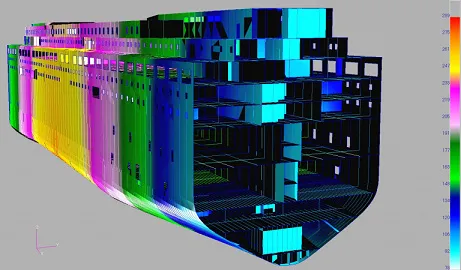
When the bow leaves the water and re-enters, or a wave climbs over the deck, local pressures can be very high for a very short time. These loads drive the design of bottom and bow-flare structure, and on fast craft they set the speed a crew can sustain. CFD with a volume-of-fluid free surface resolves the impact pressures; coupled with FEA, one way or two way, it shows how plating and stiffeners respond. That is the subject of our marine fluid–structure interaction work.
Added resistance in waves: the fuel nobody saw on trial
A ship holding speed into a seaway needs more thrust than in calm water. This added resistance in waves is a real part of fuel use in service, and a main reason why trial performance and voyage performance differ. It also matters for the minimum-power question: a ship needs enough reserve power to make headway and keep steering in heavy weather.
Potential-flow methods estimate added resistance well in longer waves. In short waves, where reflection at the bow dominates, CFD or empirical corrections calibrated against tests are needed. Getting it right is how a design team avoids an engine that looks adequate on paper and runs short at sea.
Manoeuvring: from virtual captive tests to a manoeuvring model
Manoeuvring is usually predicted with a mathematical model of the ship, such as the modular MMG-type model that treats hull, propeller and rudder forces separately, driven by hydrodynamic coefficients. Those coefficients used to come only from captive model tests. CFD now provides them through virtual captive tests: static drift, pure sway and pure yaw runs, for the actual hull and appendages.
With the coefficients in hand, the manoeuvring model simulates turning circles, zig-zag tests and stopping manoeuvres and checks them against the IMO standards. Free-running CFD of a full manoeuvre then serves as an independent check on the most critical cases.
Where AI makes seakeeping simulation operational
- Surrogate RAOs. A model trained on panel-method and CFD runs gives transfer functions for any loading condition and speed in seconds, ready for operability studies and route planning.
- Operating guidance. Speed and heading envelopes from the same models, for the bridge or the operations room.
- Digital twins. Motion and strain sensors on board recalibrate the model as the ship ages, the loop described in our digital twin work.
- Rare events. Extreme slamming or roll is rare by definition; surrogate-guided sampling focuses expensive simulations on the conditions that produce it.
From one study to a capability you keep
A single simulation campaign answers the question it was asked. The larger return comes when the setup becomes a workflow your own team runs. The next variant, loading condition or operating question then costs hours instead of weeks, and every answer is checked the same way. That is how we build seakeeping and manoeuvring work.
- Physics model. CFD and FEA set up once, as templates: geometry clean-up, mesh, solver settings and post-processing that every later run reuses.
- Validation. Mesh and time-step studies, and comparison with tests or full-scale data, so the model's uncertainty is known before it is trusted.
- Automated runs. Scripted runs over the parameters and operating conditions that matter, on your hardware or in the cloud.
- AI surrogate. A machine-learning model trained on those runs answers in seconds and says how sure it is; low-confidence questions go back to the solver.
- Decision tool. Optimisation, trade-off charts or operating guidance, in a form your engineers and operators use every day.
- Field data. Test, trial and monitoring data flow back to recalibrate the model, so it improves with every project instead of being rebuilt.
- Templates for geometry, mesh, solver settings and post-processing, documented so results stay consistent from one variant to the next.
- A validation record that ties the simulations to your tests, trials or field data, with the uncertainty stated.
- Automated runs over the parameters and operating conditions that matter, on your hardware or in the cloud.
- A trained surrogate and a simple decision tool, with the limits of its validity written down.
- Training and handover, so your engineers can extend the workflow themselves. See our training and software development services.
Questions about seakeeping simulation
Is linear seakeeping analysis good enough?
Can CFD predict slamming loads for structural design?
How do you get manoeuvring coefficients without model tests?
What data do you need?
Seakeeping is one part of our resistance, propulsion, seakeeping and manoeuvring work. Stability in waves has its own article, on parametric roll and ship stability. If your design has to perform in the sea it will meet, start a conversation.